

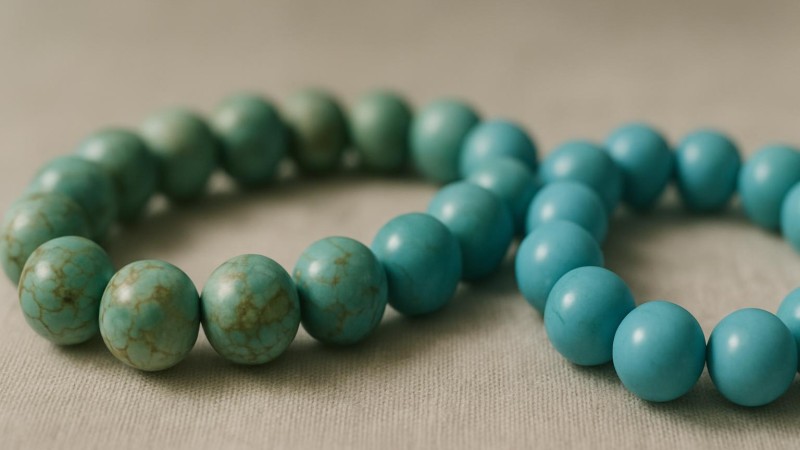
Why This Question Matters to Jewelry Makers and Collectors
Turquoise has been treasured for thousands of years for its vivid blue-to-green color, striking matrix patterns, and unmistakable natural character. It appears in ancient jewelry, ceremonial objects, trade beads, and contemporary designs ranging from rustic statement necklaces to delicate accents paired with freshwater pearls. Because turquoise is so popular, it is also one of the most commonly treated, stabilized, enhanced, and imitated gemstones on the market.
That does not automatically make dyed turquoise “bad.” Many buyers happily choose dyed or color-enhanced material for bold color, affordability, or design consistency. The important issue is accurate identification. If you are a jewelry maker, bead buyer, collector, or gift shopper, understanding the difference between dyed turquoise and natural untreated turquoise helps you make informed decisions, describe your pieces honestly, and care for the stone properly.
In this guide, we will look at what natural untreated turquoise is, why turquoise is dyed, the visual clues that may reveal color enhancement, and practical steps you can use before buying beads, cabochons, or finished jewelry. We will also cover what treatments are common, what sellers should disclose, and how to shop more confidently.
What Is Natural Untreated Turquoise?
Natural untreated turquoise is turquoise that has not been altered by dye, resin, wax, or other enhancement processes after it was mined and cut. It forms as a hydrated phosphate of copper and aluminum, which gives it the blue and green tones that people love. Variations in iron, host rock, and porosity can create a wide range of colors and patterns.
Untreated turquoise often shows subtle, nuanced color rather than a perfectly uniform bright blue. Some stones are robin’s egg blue, while others lean greenish blue, sage green, or pale sky blue. Matrix may appear as brown, tan, black, golden, or spiderweb-like veining depending on the deposit. Because untreated turquoise is often porous, it can also be softer and more sensitive than heavily treated material.
In folklore and historical traditions, turquoise was associated with protection, travel, and good fortune in many cultures. That long cultural legacy contributes to its enduring appeal in artisan jewelry and beadwork today.
What Does “Dyed Turquoise” Mean?
Dyed turquoise is turquoise that has been artificially colored to intensify, alter, or even out its appearance. In some cases, lower-grade pale turquoise is dyed a richer blue or green. In other cases, a different porous material such as magnesite or howlite may be dyed and sold in a turquoise-like color. This is where buyers need to be especially careful, because “turquoise-colored” is not the same as genuine turquoise.
Dyeing may be done alone or combined with stabilization. Stabilization generally means infusing porous turquoise with a resin or similar substance to improve durability and polish. Stabilized turquoise can still be genuine turquoise, but it is not untreated. Dye may then be added to deepen the color further.
For jewelry designers working with amethyst beads or other gemstone components, treatment disclosure matters because it affects value, care requirements, and how materials should be described in product listings or custom commissions.
Why Turquoise Is Often Dyed or Treated
Turquoise is naturally porous, and high-quality untreated material is relatively limited. Dyeing and other treatments are common for several reasons:
- To intensify color: Pale material can be made to look richer and more saturated.
- To create uniformity: Bead strands often sell better when the color matches closely from bead to bead.
- To improve marketability: Bright blue stones are especially popular.
- To mimic premium sources: Lower-grade material may be made to resemble more desirable turquoise.
- To enhance durability: Dye may accompany stabilization in porous stones.
These treatments are common in the gemstone trade. The problem arises only when dyed or imitation material is presented as natural untreated turquoise without disclosure.
Natural Untreated vs Dyed Turquoise: Key Visual Differences
1. Color Uniformity
One of the biggest clues is color consistency. Natural untreated turquoise usually has subtle variation across the surface. Even high-quality stones often contain slightly softer and stronger zones of color. Dyed turquoise, by contrast, may appear unnaturally even or intensely saturated throughout.
If every bead in a strand is the exact same electric blue with no gentle shifts, that can be a sign of dye or heavy treatment. Nature rarely produces absolute perfection across an entire lot.
2. Color Concentration in Cracks or Pits
Dye often settles into cracks, drill holes, porous spots, and matrix lines. Examine beads closely under magnification. If the blue or green color looks darker around tiny fractures or appears to pool in recessed areas, that may indicate dye penetration.
This is especially important when evaluating rondelles, nuggets, and carved stones used alongside jump rings and other findings in handmade jewelry.
3. Matrix That Looks Too Contrasted
Natural turquoise matrix can be dramatic, but the contrast usually still looks integrated with the stone. In dyed material, the body color may look so bright that the matrix appears overly stark or artificial by comparison. Sometimes the matrix is emphasized because dye darkens nearby pores and creates a sharper outline than would occur naturally.
4. Surface Sheen and Texture
Untreated turquoise may have a softer, more natural luster depending on the cut and polish. Dyed and stabilized stones can appear slightly glassier or more plastic-like, especially if resin is involved. This does not prove dye on its own, but when combined with intense color and suspicious uniformity, it becomes more meaningful.
5. Unexpectedly Bright Blue or Green
Some natural turquoise is vivid, so bright color alone is not enough to judge. Still, neon-like blue, very pure teal, or highly artificial green should prompt a closer look. Natural untreated turquoise often has depth and complexity rather than a flat, ink-like tone.
Simple At-Home Ways to Examine Turquoise
You do not need a gem lab to notice useful clues. Here are practical inspection methods buyers and makers can use.
Use Natural Light
Look at turquoise in soft daylight rather than harsh store lighting. Warm indoor bulbs or overly cool LEDs can distort color. Natural light helps you see whether the stone has nuanced variation or suspiciously flat saturation.
Check with a Loupe
A 10x loupe is one of the most useful tools for gemstone buying. Look for:
- Darker dye accumulation in pits
- Color along fractures
- Uneven saturation around drill holes
- Resin-filled texture or overly smooth surface features
If you enjoy detailed beadwork or use wire wrappers and precision tools, a loupe is worth keeping in your supply kit.
Inspect Drill Holes Carefully
Beads can reveal a lot at the drill hole. Dye may collect more deeply inside the opening, making the interior appear darker than the outer surface. On some dyed stones, the color transition is obvious near the hole edge.
Compare Multiple Beads Side by Side
A strand with every bead identical in tone, matrix placement, and saturation can be a red flag, especially for natural stone. Minor differences are normal and often desirable in untreated material.
Ask for Macro Photos
When shopping online, request close-up images of the exact stones. Good sellers should be comfortable showing drill holes, surface texture, and matrix detail. Macro photos often reveal clues that standard listing photos hide.
Tests to Avoid at Home
You may see advice online suggesting destructive or risky tests, such as scraping the stone, using acetone aggressively, applying heat, or rubbing with chemicals. These methods can damage the surface, polish, or any stabilizing treatment. They can also produce inconclusive results.
Avoid:
- Scratch testing
- Torch or heat testing
- Strong solvent experiments
- Breaking or chipping a bead to inspect the interior
If a stone is valuable or you need certainty for resale or collecting, professional gemological testing is the better route.
Dyed Turquoise vs Imitation Turquoise
One source of confusion is that not all dyed “turquoise” is actually turquoise. Some beads sold in bright turquoise shades are dyed howlite, dyed magnesite, composite material, or reconstituted stone. These can still be attractive for fashion jewelry, but they should not be described as natural untreated turquoise.
Common look-alikes include:
- Dyed howlite: Usually white with gray veining before dyeing; often colored bright blue.
- Dyed magnesite: Porous and easily dyed, sometimes sold as turquoise.
- Reconstituted turquoise: Small turquoise fragments bonded with resin and dye.
- Composite blocks: Powdered minerals and binders formed into beads or cabochons.
If you are mixing turquoise with natural materials such as sterling silver clasps, gemstone rounds, or shell components, accurate labeling helps preserve the integrity of your finished work.
Questions to Ask Before You Buy
One of the smartest ways to identify dyed versus untreated turquoise is simply to ask clear, specific questions. Reputable sellers should be able to answer them directly.
- Is this genuine turquoise?
- Is it natural untreated, stabilized, dyed, or reconstituted?
- Has the color been enhanced in any way?
- Are the photos of the exact item I will receive?
- What is the origin, if known?
- Can you provide close-up photos of matrix and drill holes?
Be cautious with vague wording such as “natural color” or “turquoise stone” if the listing does not clearly disclose treatment. In gemstone sales, precise language matters.
How Sellers Commonly Describe Turquoise
Understanding terminology can save you from disappointment. Here is what common phrases usually mean:
- Natural untreated turquoise: Genuine turquoise with no added color or stabilization.
- Natural turquoise: Sometimes used loosely; ask whether it is stabilized or dyed.
- Stabilized turquoise: Genuine turquoise treated for durability, but not necessarily dyed.
- Color-enhanced turquoise: Usually dyed or otherwise artificially intensified.
- Reconstituted turquoise: Ground material bonded together; not solid natural turquoise.
- Turquoise howlite/magnesite: Not turquoise, but another stone dyed to resemble it.
When in doubt, ask for clarification in writing before purchasing.
Does Dyed Turquoise Have a Place in Jewelry?
Absolutely. Dyed turquoise can be beautiful, especially in bold fashion pieces, color-coordinated bead strands, and designs where consistent color is important. Many makers intentionally choose treated materials because they suit a specific palette or project better than untreated stone.
The key is honesty and expectation. If you love the look and understand what you are buying, dyed turquoise can be a perfectly valid choice. Problems begin only when treated material is mistaken for untreated stone or sold without disclosure.
At PebbleBead, many jewelry makers shop with a clear design goal in mind. Knowing the difference between natural untreated and dyed materials helps you select the right beads and findings for each project, whether you are creating minimalist earrings or a layered necklace with crimp beads.
Caring for Untreated and Dyed Turquoise
Both untreated and dyed turquoise benefit from gentle care, but porous untreated stones can be especially sensitive.
- Keep turquoise away from perfumes, oils, and household chemicals.
- Store it separately to avoid scratches from harder stones.
- Wipe with a soft dry cloth after wearing.
- Avoid prolonged soaking in water.
- Do not use ultrasonic or steam cleaners.
Dyed stones may be more vulnerable to color fading or surface changes if exposed to harsh cleaners or strong sunlight for extended periods. Treated or untreated, gentle handling will help preserve the finish.
When Professional Testing Makes Sense
If you are purchasing a high-value piece, building a serious collection, or need certainty for resale, a professional gemologist can help identify whether a stone is turquoise and whether obvious treatment is present. Laboratory testing may include magnification, spectroscopy, refractive properties, or advanced analytical methods beyond what most buyers can do at home.
This is especially useful for antique jewelry, Native American style pieces of uncertain origin, or rare stones represented as premium natural untreated turquoise.
Final Tips for Buying Turquoise with Confidence
Identifying dyed turquoise versus natural untreated turquoise is not about memorizing one single trick. It is about combining observation, seller transparency, and a little gemstone knowledge. Look for natural variation, inspect matrix and drill holes, be cautious with overly perfect bright color, and learn the language used in listings.
Most importantly, buy from sellers who disclose treatments clearly and welcome questions. Whether you prefer the earthy character of untreated turquoise or the vivid consistency of dyed material, informed buying leads to better jewelry making and fewer surprises.
Turquoise remains one of the most beloved stones in the jewelry world for good reason. Its colors evoke desert skies, weathered landscapes, and centuries of adornment across cultures. Once you know what to look for, you can appreciate each bead or cabochon for what it truly is—and choose the material that best fits your design, collection, or gift idea.

Leave a Comment