
This guide covers observations and their limits, rather than certifying a material. Colour, shape, surface appearance and photographs cannot establish identity or treatment on their own. Avoid destructive home tests; uncertainty is a reason to seek professional identification, not to make a stronger claim.
Table of Contents
- 3. The Art of Identification: Reading a Stone
- 4. Colour, the Soul of a Gemstone
- 5. Clarity, Cut and the Play of Light
- 6. Hardness, Durability and the Mohs Scale
- 11. Buying Wisely: Treatments, Imitations and Trust
- 12. Frequently Asked Questions
Gemstone Science Basics
Gemology may sound technical, but its basic concepts are extremely useful for anyone buying or making jewelry. A gemstone description is really a condensed scientific profile: mineral family, color, hardness, origin, treatment, shape, size, and quality. Once you understand the main terms, listings become easier to compare and confusing claims become easier to question. Science does not remove the romance of gemstones; it gives you a clearer way to appreciate them.
Chemical composition and crystal structure
Each mineral gemstone has a chemical composition and an internal arrangement of atoms. Corundum, the mineral family that includes ruby and sapphire, is aluminum oxide. Beryl includes emerald and aquamarine and is a beryllium aluminum silicate. Quartz is silicon dioxide. Trace elements can create dramatic changes in color: chromium can make corundum red as ruby, while iron and titanium can contribute to blue sapphire.
Crystal structure affects how a gem grows, breaks, reflects light, and accepts cutting. Some minerals form hexagonal crystals, others cubic, orthorhombic, monoclinic, or trigonal structures. In bead making, the original crystal shape is often removed during cutting and polishing, but structure still matters. It can influence cleavage, directional color, and how a stone behaves when drilled or shaped.
Hardness, toughness, and cleavage
The Mohs scale ranks scratch resistance from 1 to 10, with talc at 1 and diamond at 10. Quartz is 7, feldspar around 6 to 6.5, apatite 5, and fluorite 4. This scale is relative, not linear; diamond is far harder than corundum even though they are only one number apart. A higher Mohs rating generally helps a stone resist surface wear, but it does not guarantee toughness.
Toughness describes resistance to breaking, chipping, or cracking. Jade is famously tough, even though it is not as hard as sapphire. Topaz is relatively hard but has perfect cleavage, meaning it can split in certain directions if struck. For makers, this distinction matters when selecting stones for bracelets, rings, and designs that may receive impact. Delicate stones can still be used beautifully in earrings or pendants where abrasion is lower.
Density, luster, and refractive index
Gemstones also differ in density, luster, and how they bend light. Hematite feels heavy for its size because of its high specific gravity, while amber feels light. Luster describes how a surface reflects light, such as vitreous, waxy, silky, metallic, pearly, or greasy. Refractive index helps gemologists identify stones because each material bends light in characteristic ways.
Even without laboratory tools, these properties influence the look and feel of jewelry. A strand of agate beads may feel cool and substantial, with a smooth waxy-to-vitreous polish. Freshwater pearl has a soft, layered luster that behaves differently from faceted quartz. Hematite adds visual weight and mirror-like reflectivity. Good design often begins with noticing these physical differences.
Why gem science matters to makers
Knowing science helps you prevent mismatches. A soft stone next to a sharp-edged metal component may wear faster. Porous stones can absorb oils, dyes, or cleaning chemicals. Heat-sensitive gems should not be exposed to torch work or ultrasonic cleaning. Stones with natural fractures may need gentler stringing and protective settings.
Scientific knowledge also improves communication. When a customer asks whether a stone is natural, dyed, stabilized, or heat treated, a confident explanation builds trust. You do not need to become a laboratory gemologist to make better jewelry, but learning the vocabulary helps you choose materials with intention.
3. The Art of Identification: Reading a Stone
Identifying a gemstone is detective work. No single clue is decisive on its own, but together a handful of observations narrow the field dramatically. The good news is that you can learn the basics with nothing more than your eyes, your hands and a few inexpensive tools.
Start With the Obvious
Begin by noting colour, transparency and lustre. Is the stone glassy, waxy, metallic or pearly? Does light pass through it, glow softly within it, or stop at the surface? These first impressions immediately separate, say, a transparent quartz from an opaque jasper. Note the overall shape too, since some stones tend toward particular crystal habits.
Use a Loupe
A simple ten-power loupe opens a hidden world. Inclusions, the tiny internal features of a stone, are often diagnostic. Needle-like rutile, feathery fractures, gas bubbles, or distinctive growth lines can point firmly toward an identification. Bubbles in particular often betray a glass imitation rather than a natural stone.
Weight, Temperature and Touch
Pick the stone up. Genuine stones tend to feel cool and heavier than they look, while plastic and glass feel warmer and lighter. Density, which gemologists call specific gravity, is a reliable property, and even an informal sense of heft can guide you. Run a finger across the surface to gauge texture, since some stones feel notably smooth or soapy.
Hardness as a Clue
A careful scratch test against known materials can confirm or rule out candidates, though it should be done only on an inconspicuous spot or on rough you do not mind marking. Combined with the other observations, hardness often clinches an identification. For finished tumbled stones you will usually rely on non-destructive clues instead.
Lustre and Surface
The way a stone reflects light from its surface, called lustre, is one of the most overlooked yet useful identification clues. Glassy or vitreous lustre is common in transparent stones like quartz and beryl. Waxy or resinous lustre marks turquoise and amber. A greasy or soapy look hints at jade, while a pearly sheen suggests moonstone or actual pearl. Metallic lustre points toward minerals like hematite or pyrite. Learning to name lustre sharpens your descriptions and quickly narrows the candidates before you reach for any tools.
Building a Reference Collection
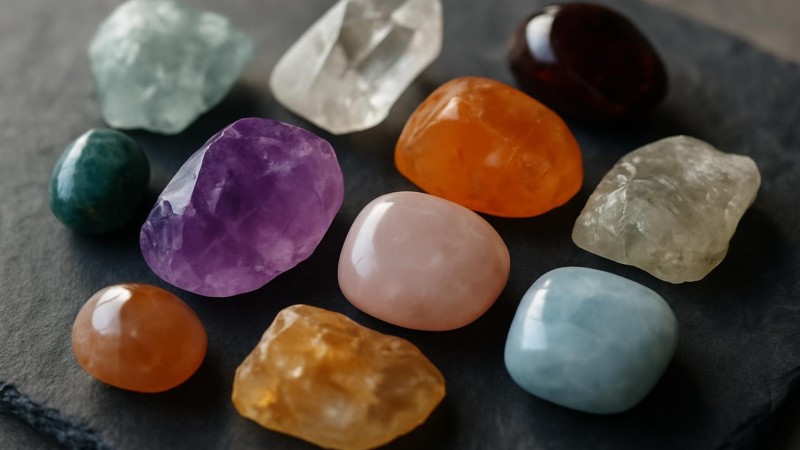
Nothing teaches identification faster than comparison. Assemble a small tray of known, labelled stones spanning the main families, and study them whenever you have a mystery to solve. Hold the unknown beside the knowns, compare colour, weight, lustre and inclusions, and the family will often reveal itself. Inexpensive tumbled stones make an ideal study set because they are affordable, show natural colour and texture, and cover a wide range of common species. Over months, this hands-on library trains your eye more effectively than any chart.
The skill grows with practice. Keep a small reference set of known stones to compare against, and over time your eye will recognise a carnelian or a sodalite at a glance.
4. Colour, the Soul of a Gemstone
If a single quality defines how we respond to a gemstone, it is colour. Colour is the first thing we notice, the most emotional aspect of a stone, and frequently the largest factor in its value. Yet colour is also subtle, built from physics that reward a little understanding.
Where Colour Comes From
Most gem colour comes from trace elements. A whisper of chromium turns colourless corundum into a fiery ruby or an emerald green; iron tints aquamarine and many garnets; copper gives turquoise its sky blue. Some colours arise instead from the crystal structure itself or from natural irradiation, as with smoky quartz. Tiny differences in chemistry yield dramatically different hues, which is why the same mineral can appear in a rainbow of varieties.
Hue, Tone and Saturation
Gemologists describe colour in three dimensions. Hue is the basic colour, such as red or blue. Tone is how light or dark it is. Saturation is how pure and vivid the colour appears, free of grey or brown. The most prized stones generally combine a desirable hue with medium tone and high saturation. A vivid, evenly distributed colour almost always outshines a pale or muddy one of the same stone.
Optical Phenomena
Some stones go beyond simple colour into living effects. Pleochroism shows different colours from different angles. Colour change, most famously in alexandrite, shifts the entire hue between daylight and lamplight. Asterism produces a star of light, and chatoyancy gives the cat's-eye line. These phenomena turn a stone into something that seems to move and breathe, and they make exceptional cabochon material because the curved surface gathers and concentrates the effect.
When selecting gemstone beads for a project, train yourself to look not just at colour but at how it is distributed. Even, lively colour reads beautifully when strung, while zoned or patchy colour can either add character or distract, depending on the design you have in mind.
5. Clarity, Cut and the Play of Light
A gemstone is a partnership between nature and craft. Nature supplies the raw material with its clarity and colour; the cutter releases its beauty by shaping it to interact with light. Understanding both halves helps you judge quality and choose the right stone for the right purpose.
Reading Clarity
Clarity describes the presence or absence of internal features. Some stones, like fine aquamarine, are valued for being eye-clean, with no visible inclusions. Others, like emerald, almost always contain inclusions, so charming that gemologists poetically call them a garden. Clarity is not a simple matter of more is better; it depends on the stone and the look you want. For beads, a few inclusions are normal and often add interest, while heavy fracturing can weaken the stone.
The Cutter's Craft
The cut determines how light enters, bounces around inside, and returns to your eye. A well-cut faceted stone sparkles with brilliance and fire, while a poorly proportioned one looks dull or leaks light through the bottom. Faceting suits transparent stones, where light can travel and reflect. Opaque and phenomenal stones are usually shaped into smooth domed cabochon forms that show off colour, pattern or optical effects rather than sparkle.
Shapes for Beadwork
In beading, the cut takes different forms. Faceted rounds and rondelles add sparkle to a strand, while smooth rounds and nuggets emphasise the stone's natural colour and texture. Chips and tumbled forms bring an organic, casual feel. Matching the cut to the design intention is part of the artistry, and a thoughtful mix of faceted beads and smooth shapes can give a piece both shimmer and substance.
When you appreciate how cut and clarity work together, you stop judging a stone by colour alone and start seeing the full conversation between the material and the hands that shaped it.
6. Hardness, Durability and the Mohs Scale
Beauty is only half the story; a gemstone also has to survive being worn, handled and cleaned. Durability is the practical dimension that decides whether a stone belongs in an everyday ring or is better kept for occasional wear. Three properties matter: hardness, toughness and stability.
The Mohs Scale
Hardness measures resistance to scratching, and it is ranked on the Mohs scale from one, the softness of talc, to ten, the supreme hardness of diamond. Quartz sits at seven, a useful benchmark because everyday dust often contains quartz, so anything softer than seven is vulnerable to gradual surface wear. Corundum at nine is exceptionally scratch-resistant, while softer stones such as turquoise, opal and many organics need gentler treatment.
Toughness Is Not Hardness
A common surprise is that hardness and toughness are different things. Toughness describes resistance to chipping and breaking. Diamond is the hardest natural material yet can cleave along certain planes if struck just so, while jade is only moderately hard but extraordinarily tough, which is why it has been carved into tools and ornaments for thousands of years. When choosing stones for active wear, toughness can matter as much as hardness.
Stability
Stability is resistance to heat, light and chemicals. Some stones fade in strong sunlight, others crack with sudden temperature changes, and a few react to household cleaners. Pearls and opals are famously sensitive and reward careful handling. Knowing a stone's stability tells you how to store and clean it safely.
Reading the Scale in Practice
The Mohs scale is not evenly spaced, which surprises many newcomers. The jump from nine to ten is far larger than the jump from one to two, so diamond is dramatically harder than corundum even though only one step separates them. For practical purposes, think of the scale in zones: stones below five are soft and need protection, stones around six to seven are everyday-capable with sensible care, and stones eight and above are highly durable. Keeping these zones in mind lets you make quick decisions at the bead table without memorising exact numbers.
For beadwork, durability guides design. Harder, tougher stones make excellent bracelets and rings that take daily knocks, while softer or more delicate stones shine in earrings and pendants that lead a gentler life. Matching stone to setting is simple wisdom that keeps your pieces looking their best for years.
11. Buying Wisely: Treatments, Imitations and Trust
The gem trade is ancient, vast and mostly honest, but a savvy buyer protects both their money and their enjoyment by knowing what they are getting. The two big topics are treatments and imitations, and the best defence is knowledge plus a trustworthy source.
Understanding Treatments
Many gemstones on the market have been treated to improve appearance, and that is not inherently wrong; some treatments have been used for centuries and are entirely accepted. Heat treatment deepens or clarifies colour in many stones, dyeing brightens porous materials like some agate and howlite, and stabilising hardens fragile turquoise. The key is disclosure: a reputable seller tells you what has been done so you can judge value fairly. Untreated stones of fine natural colour are rarer and command more, while well-disclosed treated stones offer beauty at accessible prices.
Spotting Imitations
Imitations stand in for natural stones, sometimes openly and sometimes deceptively. Glass and plastic can mimic many gems, while one natural stone is occasionally dyed to pass for a pricier one, as with dyed howlite standing in for turquoise. Telltale signs include suspiciously perfect colour, gas bubbles visible under a loupe, mould lines on moulded glass, and prices that seem too good to be true. A simple loupe and a healthy scepticism catch most fakes.
Synthetics Versus Naturals
It is worth distinguishing imitations from synthetics. A synthetic has the same chemistry and structure as the natural stone but was grown in a laboratory rather than the earth. Synthetics are real stones in a material sense and can be lovely and affordable, but they should be sold as such. Honest labelling is the whole game.
Buying From People You Trust
In the end, the single best protection is a seller who answers questions clearly, discloses treatments, stands behind their goods and offers consistent quality. Build a relationship with sources you trust for your gemstone beads and jewelry findings, learn a little more with every purchase, and your collection will grow in both beauty and value. A confident buyer is a happy buyer.
12. Frequently Asked Questions
How can I tell if a gemstone is real?
Start with simple observations: genuine stones usually feel cool and heavier than glass or plastic, show natural inclusions under a loupe, and have a consistent but not impossibly perfect colour. Gas bubbles, mould seams and suspiciously low prices are warning signs of imitations. For valuable purchases, buy from a seller who discloses treatments and, when in doubt, seek a professional opinion.
What is the hardest gemstone, and does hardness mean unbreakable?
Diamond is the hardest natural material at ten on the Mohs scale, but hardness only measures resistance to scratching, not breaking. A hard stone can still chip or cleave if struck the wrong way. Toughness, a separate property, describes resistance to breaking, and stones like jade are remarkably tough despite being only moderately hard.
Why do two stones of the same type look so different?
Trace elements, crystal formation conditions, clarity, cut and any treatments all influence appearance. The same mineral can appear in many varieties and colours depending on tiny chemical differences. Cut and polish further change how light interacts with a stone, so two pieces of the same material can look quite distinct.
What is the difference between a synthetic and an imitation stone?
A synthetic shares the same chemistry and crystal structure as the natural stone but was grown in a lab, so it is a real stone in a material sense. An imitation merely looks like the stone but is made of something else entirely, such as glass or dyed material. Both are legitimate when honestly labelled; the problem is only when they are sold as something they are not.
Are inclusions always a flaw?
Not at all. While clean stones are prized in some varieties, inclusions can be diagnostic, beautiful and even desirable. Emeralds famously contain a garden of inclusions that gemologists accept and even admire, and many natural stones carry inclusions that prove their authenticity and add character.
What does it mean when a stone is treated, and is that bad?
Treatment refers to any process that enhances a stone after it comes out of the ground, such as heating to improve colour, dyeing porous material, or stabilising fragile stones. Many treatments are long-established and entirely accepted in the trade. Treatment is not bad in itself; what matters is honest disclosure so you can judge value fairly. Untreated stones of fine natural colour are rarer and cost more, while well-disclosed treated stones offer beauty at friendly prices.
1. How Gemstones Form: A Journey Through the Earth: Gemstones for Jewellery Making: Materials, Durability, and Design
2. The Major Gemstone Families: Gemstones for Jewellery Making: Materials, Durability, and Design
7. Lore and Tradition Through the Ages: Gemstones for Jewellery Making: Materials, Durability, and Design
8. Birthstones and the Calendar of Stones: Traditional vs Modern Birthstones: Meanings, History & Jewelry Ideas
9. Care and Cleaning: Keeping Stones Alive: Expert Jewelry Care and Maintenance: The Ultimate Guide
10. Working Gemstones Into Beadwork and Jewellery: Gemstones for Jewellery Making: Materials, Durability, and Design
Conclusion: Gemstones for Jewellery Making: Materials, Durability, and Design
Related practical guides
- Gemstones for Jewellery Making: Materials, Durability, and Design
- Real or Imitation Freshwater Pearls? Visual Clues and Their Limits
- Turquoise Identification: Visual Clues, Look-Alikes, and Limits
- Buying Freshwater Pearls: Disclosure and Professional Verification
- Buying Turquoise Beads: Treatments, Labels, and Seller Questions
- Safe Cleaning Methods for Porous Gemstones and Pearls
Leave a Comment